


Anne Robinson is co-author of the Fun for Starters, Movers and Flyers series, as well as seminar presenter for Cambridge Assessment English.
Aren’t children lucky? So many things are relatively (or even totally) new for them. As a result, they don’t usually carry many negative experiences or preconceptions around with them.
At the age of 6, 7 or 8, where writing is concerned, they are at the stage where they are still developing and experimenting with writing in their mother tongue, so often any kind of writing activity (even copying) has a certain novelty value for them. Writing often consolidates work done on the other skills. It adds hands and touch to eyes and ears. In my first post of three, I’ll be sharing some ideas and activities based on writing words.
Copying and rewriting words
When asking students to copy words, add a reason for copying – add a little twist at the end.
1. In the series of words below, ask students to:
- Find the same word
- Write the word
- Draw a picture of it
bag balloon ball balloon Success will be shown by students who have identified and written the word ‘balloon’ correctly and also drawn a picture of a balloon. It’s not just mechanical copying – they have to spot the word that’s there twice.
2. Another copying activity could be to ask students to write words in order according to a given criterion. For example:
Put these areas of water from smallest to biggest:
sea lake pond ocean puddle drop
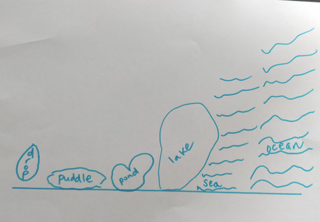
Or write the day Monday to Sunday, in order from your least favourite to your favourite.
Connections between words
Connections between words (personal or connotations) can be reinforced. For some children, writing will be the activity that helps them most to remember language. The act of actually forming the letters, or seeing them on paper (or other surface) will definitely make them more memorable for many students in our class. Some examples to help children memorise written words are:
- Why not let your students use all the colours in their pencil cases and write their words in lots of colours – for example, they can write words in ‘rainbow’ letters
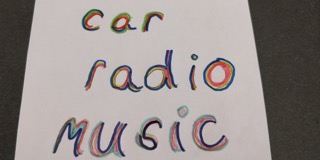
- Use different pens or tools. We all know how much students love to scribble and doodle on the board, for example! Give them board pens and let them write.
- Put a long strip of paper on the floor and let the children cover it in words they know, or base it on a theme. They can use thick felt tips and draw graffiti-type letters.
- Learners can paint their letters on a page or sheet of paper and make a poster.
- Students could write outside on the ground using chalk. (Or, you could do this inside with a blackboard or black card and chalk.)
- Get them to write words using white wax crayons. When they paint over the letters or shade over them with felt tips, the words they wrote reappear!
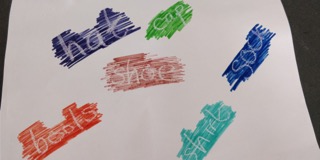
- Introduce scrabble letters or fridge magnets so they can ‘build’ words
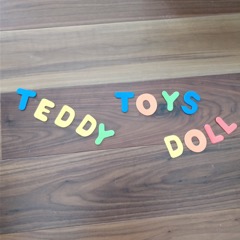
- Use an ink pad and stamp to demonstrate words.
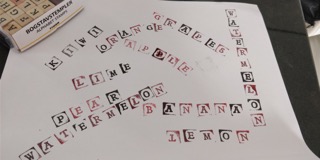
- Try ‘writing’ with fingers on other surfaces, for example, the sand on a beach or salt in a tray.
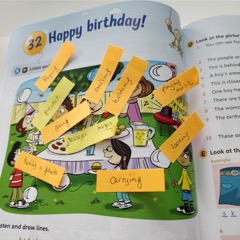
- To revise and consolidate words they have been studying, ask them to write words on stickers or mini post-its and then peel them off and label a picture in their course book, for example:
But remember! Check what students have written when they have copied words or text from the board. This will be the permanent record they have to keep and refer back to! Be especially careful if any of your students are dyslexic.