


Keeping younger learners engaged requires understanding their needs and careful planning. When we train as teachers we explore stirrers and settlers within lesson planning. You may also know them as warmers, fillers or coolers.
How do we define stirrers and settlers?
Stirrers are tasks or activities that stimulate or energise our learners. Settlers are used to calm them. They help us to set the scene for a lesson, revive and energise or quickly revise and recap work in an engaging way. They also help with classroom management and build routines at the start and the end of lessons.
Why do we use stirrers and settlers in our primary classroom?
We use them to provide a change of focus and pace to cater for students’ varying learning preferences, stages of cognitive development and concentration spans. We use them to signal various stages of a lesson and transition from one activity to another.
- They help us to maintain harmony and discipline in the YL classroom. If we see a class needs a moment to calm down, a settler might help us to regain control of the class.
- Stirrers provide an outlet for pent-up energies/frustration that may otherwise erupt into misbehaviour.
- Having a couple of activities ready also help us with time management, in situations where we finish earlier than expected.
How do we use them?
When we plan a lesson, a stirrer is usually a way into a lesson. We use them to activate our learners’ previous knowledge of a topic, target language or lexical set. Conversely, we may use a stirrer to give learners time to revise, consolidate or absorb the language we cover in a lesson.
What do we use?
Typically a stirrer would be a quick game to lead into the lesson or activity we want our students to do. Such as backs to the board, bingo, Jane says (Simon says), a running dictation of the first paragraph of a text we are about to read. The list is endless.
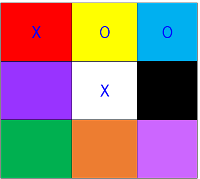
For example, you may be doing colours with your class. To start a new lesson you may want to start with a game of noughts and crosses. Start by splitting the class into two groups (‘O’ and ‘X’) to demonstrate the activity. Ask the group to choose a square by saying the colour. Students alternate and you add their ‘O’ or ‘X’. Then get the class to play in pairs.
You could substitute colours for other lexical sets (toys, food and many others) in other lessons so learners are familiar with the task but revise other lexis.

A settler may be a quieter activity, a word search, a message in code, a colour by numbers or even a story to consolidate learning. An example could be ‘Dog and bone’, an alternative to hangman. Learners suggest letters to help the dog reach its bone.
What is important is that our choice of activity is relevant to the lesson content and not a random activity chosen because it is fun.
When do we use them?
Stirrers and settlers are traditionally used at the start or the end of the lesson but do not have to be limited to this. You can use them to signal a change of activity during the lesson. They should be simple to prepare, short in length with brief instructions.
Ready-made resources
There are many resources to help teachers introduce and review lessons. This video example from Fun Skills encourages learners to revise irregular past simple verbs and asks them questions that are useful for Part 4 of the A1 Movers speaking test.
The aim of the animations is to get your learners speaking and practising language they need for the Cambridge exams for younger learners: Pre A1 Starters, A1 Movers and A2 Flyers
Stirrers and settler may or may not be a game. They can introduce new language or provide a focus for the lesson. It gets the students moving and thinking, gets them in the mood for English, helps them to reflect on their learning and helps with classroom dynamics.