


Exploring different ways to connect our younger learners with pictures, texts and classroom materials really boosts their confidence and makes lessons fun! Here are 5 ideas you can take away, today:
Idea 1: Question wheel!
Recycle, and make a useful tool for your classroom! It’s easy and quick!
Materials needed: an old CD, large white sticky labels or white paper, coloured card or strong paper, a ruler, a pen, a press stud or a paper fastener.
1. Take an old CD or DVD.
2. Using 2 large sticky labels, or two circles cut from white paper, cover both sides of the CD.
3. Draw lines across the centre so that you have 6 ‘cheese’ portions on both sides of your CD.
4. On one side, write a ‘wh’ question word in each portion: What? Whose? Who? When? Where? Why?
On the other side, write ‘how’ question words: How? How much? How many? How old? How often? How long?
5. Make two more circles from different coloured piece of card or strong paper and cut a ‘portion’ out of each circle.
6. Make a hole in the middle using a knitting needle or something similar.
7. Fasten the question wheel together with a large press stud, or a split pin/paper fastener.
Your question wheel is ready!
Idea 2: Find 8!
To kick off a new topic or unit, it’s a good idea to find out how much young learners already know.
Let’s take an example topic for A1 Movers: sports and hobbies.
1. Each pair of learners needs a piece of paper.
2. They write the name of 1 sport or hobby. They have 8 seconds.
3. Pairs pass their paper to another pair and everyone writes a different word.
4. Countdown 8 seconds.
5. Continue until every pair has 8 different words.
Tip:
Some words might be new for some learners. They can teach each other the words.
8 words for a picture – or a text
Show learners a picture, like this one, for twenty seconds. Then, hide it and ask them to write 8 words for things they saw in the picture. Give them 8 seconds for every word.
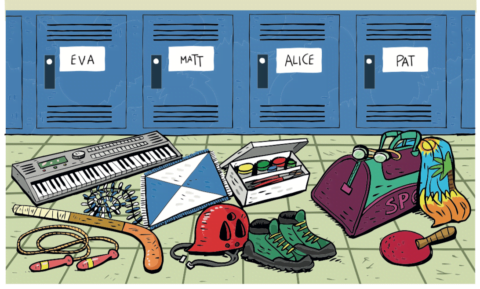
Source: Fun Skills Level 3
Follow on ideas:
1. Learners read out their words in alphabetical order.
2. Learners say their longest and shortest words.
3. Learners choose the most difficult word to spell and write it 8 times using different colours or letters.
4. Learners choose the most difficult word to pronounce and say it 8 times.
5. Use the question wheel to ask questions about the sports and hobbies.
e.g. tennis
Where do people play tennis?
Who plays tennis in this class?
Why do you like tennis?
How often do you play tennis?
Tip:
If you are teaching online, ask them first to handwrite the words, then, to type all 8 words into the chat box before they press send. This gives everyone a chance to write before they share them.
Idea 3: Think big!
Encourage learners to make connections with their world. In this example, learners say which sports or games people play with which ball.

You can extend this by asking learners to find other balls and challenge their classmates to say which sport or games people play with them. Then, they could order the balls in terms of size (small to big) or weight (light to heavy).
Some sports don’t use a ball. Get learners to thing big and find pictures, or say sports or games that don’t need a ball. (e.g cycling, running, skating, badminton, climbing, skiing, etc).Balls are round and so are other things. Ask learners to look around the room, or in their coursebook or outside, for things that are round. (e.g a clock, a cup, a head, a wheel).
Idea 4: Plan it and check it!
Before learners look at a text or visual, ask them to predict what they will see and how it will look.
For example, before you show a poster, ask learners if the poster will be landscape (wide) or portrait (tall), black and white or colour. Will it have a title, pictures?
Then, show learners the poster. They can discuss their predictions and the poster.
These predictions and observations will help them when they create their own poster.
Idea 5: Finish it!
To revise lexis from a topic or lesson, dictate the first 3-4 letters from words. Learners listen and then either say or write the missing letters. You can add a competitive element by giving them points for the number of letters they had to write to complete the word.With a text, show learners a sentence (or tell them to read and memorise a particular sentence).
For example:
In the holidays, Alice learned to skip in the garden with her cousins.
Then, show or say the first 3-4 words and they have to write the remaining words (or say them).
For example:
In the holidays, Alice ___ ____ ____ ___.
Planning, finishing, asking a range of questions, adding and thinking big are just five ways to get learners interacting with content!
Catch up on Anne’s webinar and others in our Catch Up FUN series, here.
Looking for more lesson ideas? Greg Archer shows you how to build stimulating lessons by using your materials more creatively in his latest blog post.