


We listen to stories, we tell stories, we read stories, we invent stories, we dream stories … and some of you might even write stories! So, what better way to contextualize and inspire purposeful thinking about universal values than fun stories!
In a recent webinar, Claire Medwell took a look at 5 FUN stories for nurturing universal values in the young learner classroom. From world stage to classroom stage, Claire will be working with a number of captivating short stories which contextualise universal values providing a springboard for discussion and project work in the young learner classroom.

Creating story readiness
Establishing a calm atmosphere in class is essential. Move the chairs to form a horseshoe shape to create a closer, community feel in the classroom. Use a story box or bag to create a sense of mystery and suspense. Take out the book, photos, pictures, flashcards or objects you might need to tell the story.
Why do we need to teach universal values in the classroom?
Universal means they are common values shared by all people regardless of who they are or where they live. Children aren’t born pre-programmed with a set of values. They learn them first and foremost from their families and then from their next local environment; the school.
What values do we teach in the classroom?
Here are some suggestions:
- Respect for others and self
- Sharing
- Fairness
- Kindness
- Empathy
- Honesty and trust
- Cooperation
- Caring for the environment and animals
Let’s take a look at some storytelling ideas:
Idea #1 – The Giraffe and the Monkeys
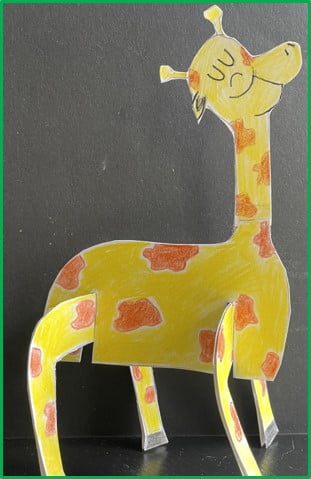 Many cultures have fables and fairy tales where animals behave or appear like human beings. Through animal personification children are able to make better sense of the world and the part humans play in it.
This story, widely available on the internet, tells the story of a selfish giraffe who eats all of the leaves and fruit from the tops of the trees. To listen to Claire tell the story in full, watch her webinar.
Try out these follow-up project ideas:
- Create a ‘sharing’ wall. Children write about things they share with others in class. E.g. Today I shared my coloured pencils with a classmate.
- Act out the story with your class. Make 3D giraffe models or finger puppets as props.
Idea #2 – Bobbie’s Rainbow
 Ask the children what colour they feel today. Ask them why e.g. I’m yellow, because it’s sunny and I feel happy.
Read and listen to Bobbie’s rainbow story (download Bobbie’s Rainbow story here).
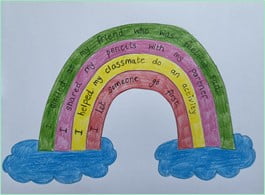
Talk to the children about kindness and being a good friend. List the things they missed about their friends during lockdown e.g. I missed playing with my friends. I missed my friend’s smile.
Talk to your class about the importance of treating people how you would like to be treated.
Why not make a ‘Colour the world with kindness’ rainbow in class?
Idea #3 – Nedda and Frankie go on a sailing trip (by Claire Medwell)
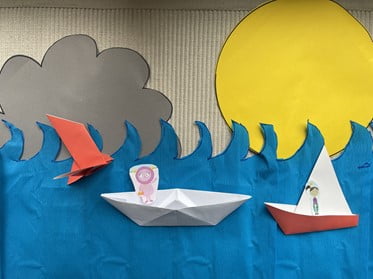
Make up your own story, based on characters the children may be familiar with. Here’s an example: a hands-on, acting out story using origami creations and other props.
Material: a cut out black cloud and sun, blue crepe paper, two origami sailing boats, a hat and a bird.
This story focuses on helping others, being a good friend and caring for animal habitats. Frankie loves fashion and Nedda loves recording videos and taking photos to share with friends.
One day, Frankie said, “Do you like my new hat?” “I love it!” said Nedda. “Can I take a photo?” “Yes, of course you can,” said Frankie.
“Hey, I have an idea,” said Nedda. “It’s a beautiful sunny day. Why don’t we go out on our sailing boats.” “Ok, good idea,” said Frankie. “We can sail to Crane Island to see the birds.”
As they were sailing, the sky turned from blue to grey. There was a terrible storm. Big waves started to crash down on their boats. Frankie’s boat wasn’t as good as Nedda’s. First one bit broke, then the other. Then the sail. “Quick! Jump,” said Nedda. “Oh, dear!” said Frankie. “My lifejacket is on the boat.”
A nearby crane dived into the sea and pulled the lifejacket out of the boat, dropping it carefully into Nedda’s lap.
Luckily, the storm passed, the sun came out again and the friends sailed safely on to Crane island.
“Phew!” said Nedda. “We’re here now.” “We must say thank you to the crane.” They waved and showed thanks to the crane who was laying its eggs in the sand. The crane flew off. Two young boys were walking towards the eggs.
“Come on,” said one of the boys. “Let’s take them,”. “No, no!” shouted Nedda and Frankie. You mustn’t take the eggs! We must care for the cranes and their habitat.
The boys turned and ran off into the distance. “Phew! What a day!” said Frankie.
One good turn deserves another.
Watch the full webinar
For more ideas on using these stories and others with your students, catch up on Claire’s webinar in our Catch Up FUN series.
If you enjoyed this article, make sure to check out Jane Ritter’s recent blog post with 5 fun ideas to use self-evaluation with young learners.