


Meet Bobbie, Skippy and Himmy! As a part of our support for teachers of Pre A1 Starters, A1 Movers and A2 Flyers, we are continuing our series of exam vocabulary worksheets. Each worksheet introduces children to a unique character designed by children from around the world with fun activities to help them prepare for their exams.
This week, we introduce Bobby, Skippy and Himmy designed by children in Uruguay, Argentina and the United Kingdom. Here are some ideas for introducing the worksheets to classes:
Meet Bobbie – Pre A1 Starters
 Start with a fun warmer to revise body vocabulary and colours by playing a game. ‘Teacher says: Point to your (hair/ eyes/ears/nose)! Open your mouth! Clap your hands! Wave your (arms/legs)!’*
‘Teacher asks: Where’s black/blue/brown/green/grey/orange/pink/purple/red/white/yellow.’* *If you don’t start with ‘Teacher says or asks:’, then learners shouldn’t do anything!
Share the Bobbie worksheet with learners by giving out photocopies of pages 1-2 or by sending it to their tablet or computer. Point to Bobbie and say: This is Bobbie. There are lots of colours in Bobbie’s face and hair.
How many can you count? (9)
When checking answers after exercises 1 and 2, to challenge learners more, ask them to say sentences about Bobbie. e.g. Bobbie’s eyes are white and black. Bobbie has got red, orange, green, blue and purple hair.
Before learners start writing words in 3, they should read the whole text first. You can read the text while learners listen and follow. Ask: How many sentences are there? (4) How many lines/numbers are there? (3).
When learners finish 4, they can show each other their pictures and say their sentences. Everyone listens to see how many people like the same colour, fruit and food as them and what things are great to look at.
Meet Skippy – A1 Movers
Play a game to revise family words. Say the first 2 letters of family words (dad, brother, mum, sister, cousin). Learners listen and write both letters, then add the missing letters to write the family word. Say: 1, 2, 3. Learners say all the letters to spell each family word.
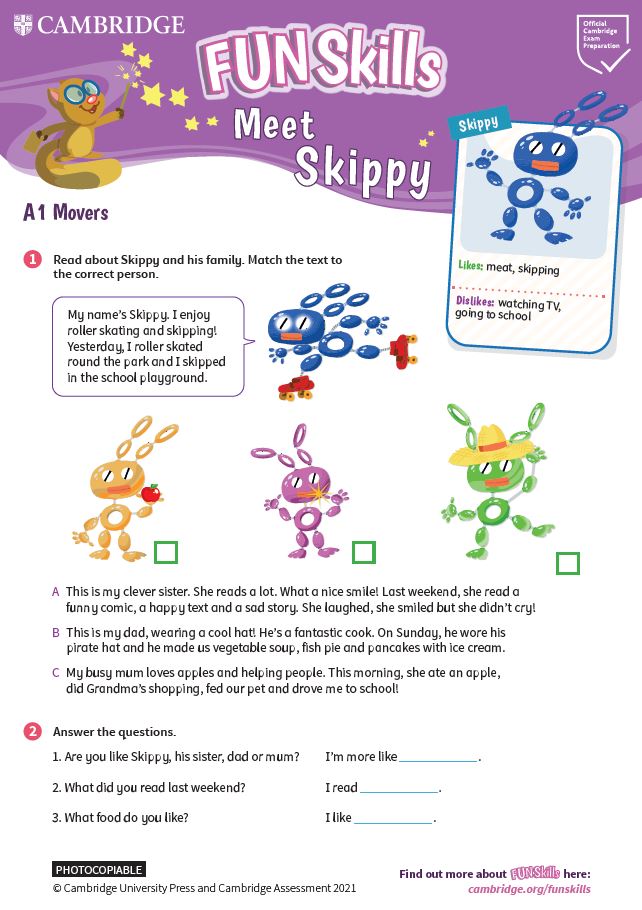
Point to Skippy on the worksheet and say: Let’s meet Skippy! What’s Skippy doing? Where did Skippy skate yesterday? What other things does Skippy like doing? Learners say their ideas then read the text to find out.
After writing their answers in exercise 2, learners stand up and try and find someone who is like the same person in Skippy’s family, read the same thing last weekend and likes the same food.
Learners write about Hoppy, Skippy’s cousin, in 3 then ask them to compare their ideas. Give an example with your own ideas: I think that Hoppy’s hobby is hopping! I think she hopped to the shops yesterday!
After learners colour the circles in 4 to make the sauce and the milkshake, they show their pictures to their classmates and invite them to try their sauce and milkshake.
To support learners, show them some useful language:
Would you like to try my milkshake/sauce? It has ……………………. in it. Look! I put it in a nice…………………….
Meet Himmy – A2 Flyers

Challenge learners to write, then say the letters of the alphabet in English. Time them to see how long it takes them to say all the letters.
Encourage them to practise saying and spelling school subjects.
Share the Himmy worksheet so that learners can complete the exercises.
After exercises 2 and 3, learners can add more time words and time themselves saying all the time words.
After exercise 4, learners could find out information about a famous astronaut or engineer and share it. Or, they could prepare a similar exercise with things that people do in different jobs, like an artist, a business person, a farmer, or a firefighter.
Follow-up ideas
Learners can write their own character cards like the ones for Bobbie, Skippy and Himmy, using a photo or drawing of themselves. Or, they could draw a new character and complete the card.
Download the worksheets by clicking on each of the images above. Otherwise, you can download them here:
Pre A1 Starters – Bobbie worksheet
A1 Movers – Skippy worksheet
A2 Flyers – Himmy worksheet
For more ideas on preparing young learners for exams, catch up with our experts in our Catch Up FUN series, here.