


As classes restart in many parts of the world this month, it’s the perfect time to revisit classroom activities that have appeared on the World of Better Learning. These activities are great for starting the school year with new groups of younger learners.
These activities encourage students to find out more about each other and their learning environments through talking about families, favourites, holidays, and other personalised topics. This is good for:
- checking what the children already know
- helping them learn to work together
- encouraging them to form relationships with other children and adults
- feeling a part of the classroom community – in class or online
Community building activities create a positive beginning to a school year and help the children become more confident in their learning.
Finding out about each other
Let’s start with Find 8!, an idea from Anne Robinson.
To kick off a new topic or unit, it’s a good idea to find out how much young learners already know.
Let’s take an example topic for A1 Movers: sports and hobbies.
- Each pair of learners needs a piece of paper
- They write the name of 1 sport or hobby. They have 8 seconds
- Pairs pass their paper to another pair and everyone writes a different word
- Countdown 8 seconds
- Continue until every pair has 8 different words
Source: 5 fun ideas to get young learners to interact with content by Anne Robinson.
This idea is easily adapted by changing topics or extending countdown time. You can also ask the students to work together when they write their words.
5 things
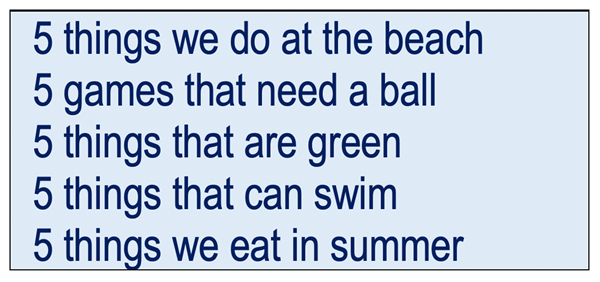
Another variation on this is 5 things, as introduced by Jane Ritter in her blog post: 5 fun ideas to use self-evaluation with young learners. As Jane says, “I would slowly reveal the brainstorming points below and give learners 1-2 minutes to write words they remember”.
Reveal each brainstorming point and give students 1 or 2 minutes to list all they can. This could be done in small groups, with the groups sharing the information they have found out about each other. Try changing topics, for example: 5 colours, 5 things in the classroom, 5 animals, or change the themes: my holiday, my new classroom, and so on.
Working with what’s around you
For familiarising your learners with their immediate learning environments, vocabulary including furniture, learning materials, rooms in the school, and so on will be useful. Here’s an idea for doing this, including downloadable worksheets:
Meet Max
This activity uses one of our FUN word activities worksheets
- Point to a chair in the classroom or show the Pre-A1 Starters flashcard of a chair (download here) and ask: What’s this? (a chair). How do you spell chair? (c-h-a-i-r). Write the five letters on the board or screen, but in a jumbled order. Then ask a learner to write them in the correct order to spell ‘chair’.
- Then, either dictate or write jumbled letters to spell other furniture words. Learners write them in the correct order to spell the words. You can point to furniture or show flashcards for support.
- To check answers, put the flashcards in different places in the classroom and get one or more learners or the whole class to point to the picture as they say and spell the word. Table, t-a-b-l-e, table!
Follow up:
- Point to Max in the family picture on page 1 and say: This is Max and this is Max’s family. How many brothers and sisters has Max got? (3 and one of them is a baby.)
- For a follow up, you could go back to Max’s character card and talk about Max’s dislike. (He doesn’t like cleaning his room.) Learners could say one thing that they don’t like doing but is important because they should help at home.
- Learners can write their own character cards like the ones for Max, Oksi and Hunter, using a photo or drawing of themselves. Or, they could draw a new character and complete the card.
Source: FUN word activities: worksheets for pre A1 Starters, A1 Movers and A2 Flyers – Part 3 by Anne Robinson.
Posters are always popular
Stick them on the wall, project them onto a whiteboard, or share them on a screen. Use these visual aids to help the children build connections with what they already know and each other. Here’s an idea using one of our A1 Movers posters. This poster focuses on A1 Movers Reading and Writing Part 1 and Speaking Part 1. For Pre A1 Starters and A2 Flyers, you’ll find more posters and ideas in this blog post.
At the fairground
- Look at the picture (e.g. for 30 seconds) and remember what they can see. Then share the words they know
- Next, without showing the picture, ask the children the questions from the poster. Afterwards, show the poster and check their ideas
- Now, in groups or individually, study the two pictures and decide what the differences are between them
- Encourage expressions such as “In the first picture there’s a … but in the second picture I can see a….”.
Follow up idea: ask students to write new questions about the poster, and then share with the class.
Source: Six ideas for using posters in class by Stuart Vinnie.
Finally, adding an element of creative drama helps students to engage directly with the environment around them. And, boosts their self-confidence and self-esteem with encouragement from peers and their teacher. In this video, Rachel Jeffries introduces some great ideas for loosening up a new class.
Source: Creative drama activities for the classroom by Rachel Jeffries.
Watch our young learner experts share more ideas in our CATCH UP FUN series!