


There are over 100 European languages spoken today. To celebrate European Day of Languages, Matt Norton looks at where these languages come from, how they’re connected, and how they got to where they are now.
There are over 750 million people in Europe, if we assume Europe goes up to the Ural mountains, and down to Georgia, excluding the Asian part of Turkey. About 94% of Europeans speak languages from the enormous “Indo-European” (IE) language family. The “Indo” part shows that it also has an Eastern branch, which includes Hindi and Persian. This family’s original location isn’t clear, but it was perhaps around the Black Sea and the Caucasian Mountains in Eastern Europe. This means English is more closely related to Hindi than to Finnish, which is in a different family.
Other European families include Uralic languages (including Hungarian, Finnish, Estonian, Sami), Turkic languages, the isolate Basque, and in the Caucasus there are smaller families including Georgian and Chechen. Maltese is a descendent of Arabic written in the Latin alphabet, spoken in Malta and influenced by Romance languages. Speakers of Indo-European gradually spread across Europe from around 5000 years ago (around the time the great Egyptian pyramids were built). The languages evolved over time, splitting into branches, e.g. the Celtic, Italic (including Latin), Germanic and Balto-Slavic, which later split into the languages we know today.
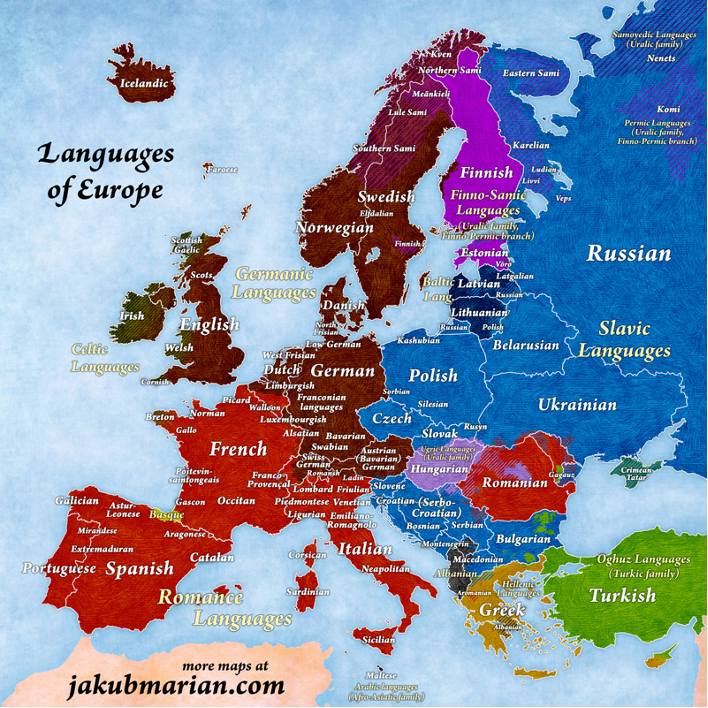
What was Europe like before the bigger language families arrived?
We don’t know much about most pre-Indo-European languages of Europe, as there are no descendants still alive, apart from the Basque language. Basque is interesting because it is both an isolate (with no existing relatives), and it is grammatically more similar to Turkic or Caucasian languages than to IE. There are many known extinct languages. At least 20 may have contributed to IE languages, while about 17 are attested in inscriptions. Some scripts remain undeciphered, such as the Linear A script, associated with a Minoan language of Crete.
Arrival of the big language families
The big families tended to migrate westward from the East. The Uralic languages may have originated in the area of the Ural Mountains, while the Turkic languages are from further east, in the regions around Mongolia.
We can see that IE languages have some shared culture, such as Roman, Greek and Hindu religions with some related names of deities. Note that the origin of the languages is not the same as the genetic origin of the people or the cultural origin, but these are interrelated. Some IE languages, e.g. Greek and Celtic, are believed to have split from the parent language earlier, while others, e.g. Baltic and Slavic, may have diverged later. Other groups are Armenian and Albanian.
What was the original Indo-European language like? We call this Proto-Indo-European (PIE). Of course, we don’t know exactly what it was like, but a “reconstructed” PIE has been developed in detail. It had eight or nine noun cases, three genders: masculine, feminine and neuter (originally just “common” vs neuter); singular, plural and “dual” for two of something. The root words may have always had inflection, e.g. nouns always had a case ending, unlike the bare nouns we get in English. There was also the vowel “ablaut” (vowel change) reflected in English tooth vs teeth. PIE may have had a “pitch accent”, where one syllable in a word has a different pitch from the others.
Romance languages
Although Latin was part of a bigger group, Italic, of which the others have now disappeared, the Roman Empire left behind the Romance languages. Each is descended from vernacular Latin, and they have been influenced by neighbouring languages, giving them distinctive features. The Eastern Romance languages include Romanian. The most conservative of these languages may be Sardinian. They form a dialect continuum, and it is hard to draw boundaries to say what are, or are not, individual languages.
Germanic languages
Germanic languages have two main groups. The Western, which includes German, Dutch and English. And the Northern languages of Scandinavia, which are descended from Old Norse, associated with the Vikings. The Germanic peoples spread over Europe, including in England where they mostly replaced Celtic languages. Russia is named after a Germanic tribe, as is France. Germanic tribes are known for having been Barbarians in the Roman Empire, e.g. Franks, Lombards, Vandals. The Gothic languages in this group are now extinct.
Baltic (Latvian and Lithuanian) and Slavic languages
These are grouped in the same branch, as they have a lot of features in common. The Slavic languages were spoken in an area around Poland or Ukraine, and there have been Slavic speakers in this fairly large area for a long time. Lithuanian is interesting because it is one of the most conservative of the “ancestral” Indo-European features, such as noun and verb endings, and it has a lot of noun cases.
We could at this point consider “Where do cases and grammatical gender come from?” Cases for subject and object may have come from animate vs inanimate distinctions, and positional cases from “postpositions”, like prepositions, but after the noun. These are found in Finnish, Basque and Turkish, for example. Grammatical gender is related to animate-inanimate distinctions, since neuter is usually for inanimate objects, and to noun classes, groups of nouns which have similar properties.
| English | Romanian | Polish | Irish | Georgian | Basque | Finnish | Turkish | Maltese |
| What is that | Ce este asta | Co to jest | Céard é sin | Ra aris es | Zer da hori | Mikä tuo on | Bu nedir | Dak x’inhu |
| One, two, three | Unu, doi, trei | Jeden, dwa, trzy | A haon, a dó, a trí | Erti, ori, sami | Bat, bi, hiru | Yksi, kaksi, kolme | Bir, iki, üç | Wieħed, tnejn, tlieta |
In Europe, the top languages spoken are English (260 million), French and German, Russian and Italian, while the top first languages are Russian (106 million), German and French, Italian and English. These are followed by Spanish, Polish, Ukrainian, Romanian and Dutch, for both total speakers and native speakers in Europe. Many Europeans are bilingual or multilingual.
Want to know more?
We have seen that there are many languages all over Europe. These spread out, moving, mixing and changing over time to reach what they are today. Indo-European is the world’s largest family of languages. Their movements involved empires, cultures and religions. Why not incorporate the history of languages into your ELT classroom? If you’re interested in learning more about the origins, try the resources below:
- Wikipedia: Languages of Europe lists all languages spoken in Europe.
- Detailed map of regional dialects and accents throughout Europe (dialects are shown in their native languages).
- Early Indo-European Online from University of Texas contains ancient texts.
- Wikipedia: Indo-European Languages contains details about the linguistic aspects.
- Ancient.eu Indo-European languages and other ancient resources.