


As teachers and educators we play an important role in helping our learners develop the knowledge, skills, and attitudes they need to flourish as citizens of the world, and many of these skills relate to sustainability.
‘Sustainability encompasses the knowledge, skills and attitudes we need to ensure a fairer, brighter future for people and the natural world’
The Cambridge Sustainability Framework for ELT maps sustainability into four dimensions: knowledge, values, innovation, and transformation. In this post, we take a further look at what the knowledge dimension involves, and how we can help our learners to develop their skills in this area.
What do we mean by “knowledge”?
Understanding sustainability
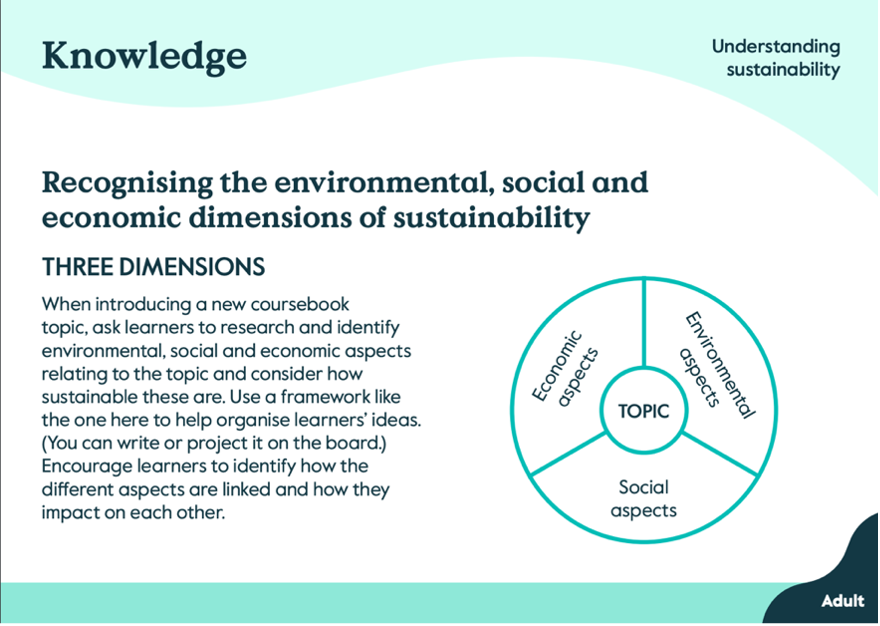
Often when we think of sustainability, we think of the environment, and our impact on the natural world. But sustainability is not only about the natural world. It’s also about ensuring that local and global communities are healthy and equitable, now and in the future, and about making sure that economic activity has a positive impact on people and the wider natural world. It is important to recognise that these three aspects of sustainability – environmental, social and economic – are interrelated.

Understanding sustainability: Classroom tips
Encourage learners to notice and explore relationships between topics they are already studying and their wider environmental, social and economic impacts. Use questions such as:
- How does this impact on the environment?
- What people are involved in this and how are they affected?
- Who profits financially from this?
To understand this, we need to engage with, explore, discuss and critically evaluate a range of information and data relating to sustainability, for example in the form of texts, infographics, charts, videos, audio, etc. We also need to explore existing and potential obstacles to sustainability. These obstacles might be psychological (such as a person’s knowledge, beliefs and values) or contextual (such as group norms, or a lack of funds). Broadening the discussion by including, respecting and celebrating diverse voices and viewpoints, especially when they might be underrepresented, helps us gain a deeper understanding of sustainability issues.
Thinking in systems
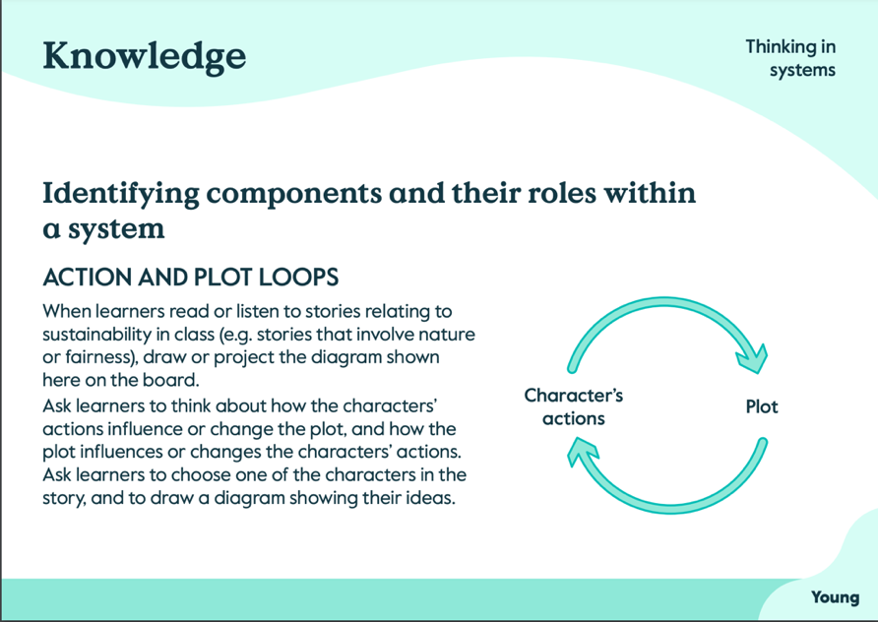
Our world is made up of systems – sets of things working together – from the water cycle to the immune systems in our bodies. The ability to think in systems is important if we are to successfully understand and address sustainability issues. Like a recipe for cooking a meal, if we change one part of a system it impacts on the other parts, and the system as whole.
Developing a systems thinking approach involves identifying components within a system and exploring their role, as well as making connections within and between systems. It also involves understanding the observable and hidden consequences of sustainable and unsustainable behaviours and practices, and we can do this by exploring how the parts and processes within a system impact on environmental, social and economic sustainability. When we recognise and understand these consequences, we can start to identify how a change in part of a system might lead to alternative, more environmentally, socially and/or economically sustainable outcomes.
Thinking in systems: Classroom tips
Encourage learners to look for connections, such as:
- Cause and effect relationships
- How two or more things might impact on each other in a circular fashion (feedback loops)
- Systems in the world around them, such as transport systems or classroom routines
When learners make connections, invite them to illustrate their ideas and think about what would need to happen for different effects and outcomes to change.
Appreciating interdependence
As people we impact and depend on each other and the wider natural world. Humans are a part of the wider natural world, not independent from it, and recognising this is important to ensuring a sustainable future for all. Appreciating interdependence is about understanding our own and others’ relationships with local, regional, national and global communities, with other life forms, nature and the environment. This includes exploring how living beings in an ecosystem depend on each other for survival and growth. It also includes understanding our social and environmental responsibilities. We can do this by exploring the environmental, social and economic roles we and others have within our local and global communities, and identifying positive behaviours within these groups. When we appreciate interdependence, we can start to explore how sustainability can positively impact both current and future generations of humans, other living beings, and the wider natural world.
Appreciating interdependence: Classroom tips
Encourage learners to think about how everything comes from and is a part of nature. Invite learners to research and discuss where things come from, using questions such as:
- Where is this made, how, and by whom?
- What do we need from the natural world in order to make this?
- How does our making this impact on the natural world?
Developing sustainability knowledge in the classroom
To help you integrate the development of sustainability skills into your teaching, we’ve created a set of activity cards for different stages of learning. These provide a range of activities for each core area of the Cambridge Sustainability Framework for ELT. Here are some examples from the knowledge dimension for different stages of learning:
Understanding sustainability: adult learners
Thinking in systems: young learners
Appreciating interdependence: teenage learners

Find more inspiration and activities for helping your learners develop their sustainability skills in the Knowledge dimension in our activity cards for Young Learners, Teenage Learners and Adult Learners.
Want to learn more about the Cambridge Framework for Sustainability in ELT, and get more free activities for your classroom? Check out our next blog in the series, “Integrating sustainability: What do we mean by “values”?”
Teaching sustainability helps learners to develop the knowledge, skills and attitudes they need to flourish as citizens of the world. Take a look at our “Sustainability Skills” page, and discover tips on how you can integrate sustainability into your English classroom.