


As teachers and educators, we play an important role in helping our learners develop the knowledge, skills, and attitudes they need to flourish as citizens of the world, and many of these skills relate to sustainability.
‘Sustainability encompasses the knowledge, skills and attitudes we need to ensure a fairer, brighter future for people and the natural world’
The Cambridge Sustainability Framework for ELT maps sustainability into four dimensions: knowledge, values, innovation, and transformation. In this post, we take a deeper look at what the transformation dimension involves, and how we can help our learners to develop their skills in this area.
What do we mean by transformation?
Understanding agency
To address sustainability issues, we need to be able to take action and make choices about what action to take: we call this agency. Sustainability issues can often make us feel powerless, but by recognising our own agency, we can identify ways in which we can make positive changes – no matter how small – on our own or as part of a group. Part of understanding agency is about recognising the relationship between agency and outcome.
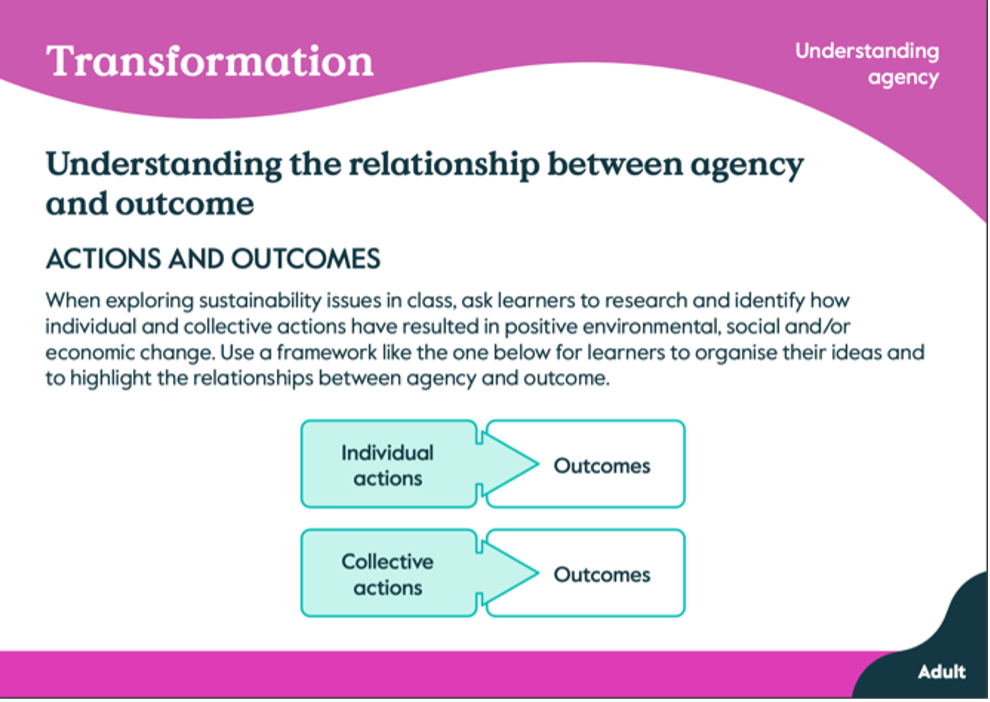
Identifying and exploring how individual and collective actions have resulted in environmental, social and/or economic change can help us understand this relationship. Comparing the impacts and outcomes of both individual and collective actions can help us understand how working together can not only make positive change more possible, but also more effective. By understanding agency, we can also inspire agency in others – encouraging different people and groups to take action and make positive, sustainable changes.
Understanding agency: Classroom Tips
Encourage learners to think about their own individual agency and collective agency, by asking questions such as:
- What can I do alone?
- What can we do together that I can’t do alone?
- How will the outcomes be different if we work together?
When learners make a statement or give an opinion on a sustainability issue, invite them to think about how they might say this to different audiences. For example, ask whether they would change what they say or how they say it if they were talking to:
- someone who thinks the issue isn’t important
- someone who doesn’t know anything about the issue
Working together
Together we are stronger. Working together effectively increases the chances of making positive change happen. Appreciating cultural diversity by developing awareness of, respect for and sensitivity to different cultures, can help us build positive relationships and interact more effectively. Our interactions need to be fair, respectful and equitable, and the tasks and projects we engage in should promote social inclusion by ensuring equal opportunities for all, regardless of their background. Appreciating cultural diversity, encouraging fair, respectful and equitable interaction, and promoting social inclusion, lay the foundations for developing meaningful collaborative relationships with others to work towards positive and sustainable change.
Working together: Classroom tips
- Promote a collaborative classroom by setting up tasks that require learners to work together in groups. Encourage them to take on different roles and support each other when working together.
- Integrate projects that culminate in a clear outcome that learners can see, such as posters, presentations or events. Encourage learners to celebrate their achievements in group projects, and recognise how the result was achieved by working together.
- After group work, encourage learners to reflect on how their individual contributions fit into the whole task, and how the success of the task is the responsibility of the whole group.
Making positive change
Making positive change involves acting as a global citizen. This means recognising and exploring how identity transcends geographical borders, that we are part of a global community, and making sure our behaviours are in line with this. Connected to this is the idea of accountability – the fact of being responsible for our actions and being able to give a satisfactory reason for them. Holding ourselves and others to account is more likely to lead to positive change.
We also need to promote a culture of peace and non-violence within our local and global communities, and we can do this by encouraging constructive dialogue, developing empathy and compassion, and ensuring that everyone is valued and able to participate. These actions and behaviours enable us to take practical and positive sustainability action for present and future generations of people, other life forms, and the wider natural world.
Making positive change: Classroom tips
- Encourage learners to hold themselves to account by inviting them to give reasons for the decisions they make in classroom tasks and projects.
- Encourage learners to explore their global identity and recognise themselves as a global citizen by inviting them to identify their relationships and connections with different countries and cultures, and to consider how these connections contribute to their own identity.
- Promote a culture of peace and non-violence in your classroom by encouraging learners to deal with disagreement with kindness and respect. Invite learners to listen carefully and try to understand others’ viewpoints when they disagree about an issue.
- Carry out classroom projects that provide opportunities for learners to take practical and positive sustainability action, such as activities to help the environment, making informed consumer choices, or seeking out more sustainable product suppliers in the workplace.
Developing transformation skills in the classroom
To help you integrate the development of sustainability skills into your teaching, we’ve created a set of activity cards for different stages of learning. These provide a range of activities for each Core Area of the Sustainability Framework for ELT. Here are some examples from the transformation dimension for different stages of learning:
Understanding Agency: Adult learners
Working together: Young learners

Making positive change: Teenage learners

Find more inspiration and activities for helping your learners to develop their sustainability skills in the transformation dimension in our activity cards for Young Learners, Teenage Learners and Adult Learners.
Teaching sustainability helps learners to develop the knowledge, skills and attitudes they need to flourish as citizens of the world. Take a look at our “Sustainability Skills” page, and discover tips on how you can integrate sustainability into your English classroom.

Our promise to the planet
We’re making big changes to become carbon zero, watch our video to learn more about our journey.