


By Sarah Ellis and Allen Davenport
As a teacher preparing students for exams, you’ll find yourself taking on extra roles and responsibilities. However, this doesn’t necessarily mean more stress for you or your learners. When students have the right resources at the right moments, the exam journey towards taking a Cambridge English Qualification becomes both achievable and enjoyable. And in turn, your teaching is a more rewarding experience. So how can we guide students on the path to success?
Create a supportive atmosphere
To create a supportive atmosphere, you’ll need to find the balance between challenging students and boosting their confidence. It’s essential to avoid overwhelming them with exam practice or grouping them right away based on their language skills. Instead, focus on setting goals, fostering familiarity with the test and each other, and presenting the upcoming exam as a challenge well within their capabilities. This will help your students grow increasingly confident about reaching their goals.
Teaching with an exam in mind also means we should integrate learning and assessment throughout the course. Exam success doesn’t come from blindly working through course material or continually checking answers on practice tests – it’s about making the most of the resources available. With the right approach, your learners will feel confident that they can apply the language skills they’ve developed in the classroom to the exam – and ultimately, to their lives.
Introduce the exam
While it might be tempting to give students the experience of taking a mock test straight away, don’t do this! A much more engaging and positive approach is to use authentic practice test material early in the course. Here’s a structured procedure that you could use to guide your students:
Explore the format of the papers
We like to provide students with an Authentic Practice Test Book that has more than one exam. Make sure they don’t write in the books, and it’s good if they can share one book within a small group, exploring the pages together.
Tell students not to try to answer the questions on the test; instead, encourage them to explore the structure of the exam and look at the different parts and tasks. Get them to notice how the different tests may have the same structure, number of questions, and question formats.
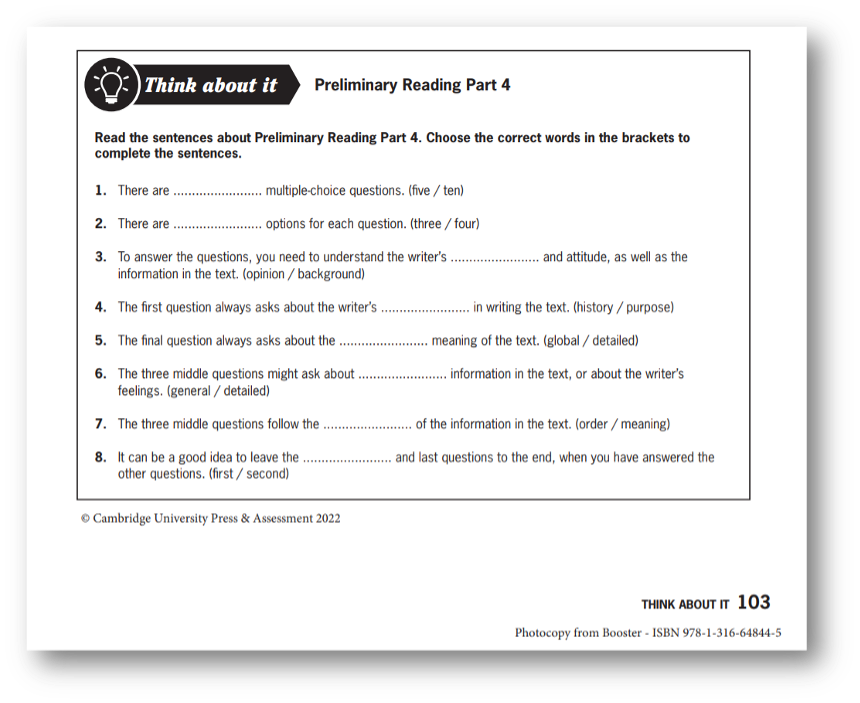
You could even make a quiz based on the format of the exam or give them a guided worksheet to explore sections of the exam, like those in the Cambridge English Exam Booster books:
You could also adapt questions like these into games and activities. For instance, you could cut up the questions and give them to half the class, and cut up the correct answers and give them to the other half. The students could then search for the person who completes the question with the correct answer, leading into a discussion about the exam.
Guide discussions about students’ attitudes towards the exam
After going over the exam format, it’s a good idea to ask students about papers and sections that appear easy to them, and which ones seem more challenging. This helps students reflect on their own ability in a friendly and approachable way. Encourage them to say which parts they’re confident about and which parts they might want to focus on improving during the course.
Also remind students that the exam is the destination of their journey, not the start! It’s perfectly normal to find some parts of the course more difficult at the beginning. This way students stay balanced. They won’t feel too worried by the challenges, and likewise they won’t be overconfident if they’ve had a few initial positive results.
Dive into the exam handbook
After the students have had a chance to analyse the practice test, introduce specific sections from the official exam handbook. This can help clarify any confusion about the format and what’s expected of them.
Relate the exam to your sourcebook
If you’re using a coursebook that includes details and exercises related to the exam, guide the students through the chapters. Highlight how their regular lessons match up with the exam components.
If students are unsure about any sections or components, go through them together. This encouragement can be a significant confidence booster. We want students to be positive about the coursebook and see it as a resource to help them progress.
Move forward with confidence
Our goal as educators stretches beyond just preparing learners for an exam. We want them to benefit from the entire process. When students understand the exam’s structure and see how it fits with their regular classroom learning, the test transforms into a challenging yet reachable goal. It’s perfectly normal that students will make mistakes and have problems along the way. But if we give them a positive and realistic understanding of the ultimate goal, and equip them with the right resources, they’ll have a positive start to their exam journey and will move forward with confidence.
Resources to download
Use these samples from the Cambridge Exam Booster series to help introduce students to the format of the exam.
A2 Key and Key for Schools Exam Booster Photocopiable exam resources for teachers
B1 Preliminary and Preliminary for Schools Exam Booster Photocopiable exam resources for teachers
B2 First and First for Schools Exam Booster Photocopiable exam resources for teachers
C1 Advanced Exam Booster Photocopiable exam resources for teachers
Is this article useful for your exam classes?
We have more articles like this coming soon in our Exam Preparation Journey support site, which will be released in January. Sign up to our Newsletter for Teachers to get more information when it launches.