


Mastering academic writing is challenging to all students, but it’s especially difficult for non-native English speakers. How can we as writing teachers help our students become successful writers when we have so much to cover? One aspect of writing that takes a lot of time to learn and that we often don’t have enough time to work on in class is editing. The primary goal of editing is, of course, to produce error-free writing. After all, grammatical, spelling, and punctuation errors can make it difficult for the reader’s comprehension, while errors in structure and organization weaken arguments. In this blog, Randi Reppen shares three tips for editing practice that can be used in writing and grammar classes.
Tip 1: Identify the trouble spots
Before we can help students edit their work, we need to identify typical problem areas for them. Those of us who have been teaching for a while often have a sense of what’s going to give students trouble. However, new teachers, or even experienced teachers who are teaching a group of students with different first languages than they’ve taught before, might encounter unexpected errors.
As much as possible, we need to anticipate the mistakes that students consistently make and provide guidance on how to avoid them. At the same time, it’s important to recognize that we can’t correct every mistake, nor would it be productive. Instead, we need to identify patterns of errors that interfere with comprehension. How? Here are two ideas that can help:
- Give a short in-class writing assignment and then look through these for patterns of errors: what mistakes are several students making? Then focus correcting on those errors.
- If there aren’t patterns of errors across student submissions, identify specific errors that interfere with comprehension.
Naturally, this takes time. Fortunately, resources exist that will help identify trouble spots. For example, Cambridge’s Grammar and Beyond series contains an Avoid Common Mistakes section in each unit based on an analysis of a large, principled collection of student writing. Look at Figure 1 for common mistakes low intermediate students (CEFR A2-B1) make with the simple past.
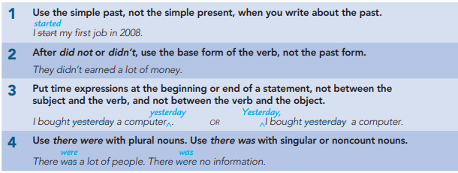
Notice only four mistakes are presented. It’s important not to overwhelm students with every possible mistake, but rather to focus on the ones that are most common and that might impact comprehension for the reader.
Tip 2: Practice editing someone else’s writing.
How many times have we edited our own writing only to find mistakes that we missed at a later reading? Imagine how much more difficult this task can be for our students who are still learning the language while also learning how to write academic papers. For students who may lack the confidence and tools to edit their own work, it’s easier to find mistakes in someone else’s writing. Because the writing is not as familiar as their own writing, students tend to read more carefully. Plus, they’re not as attached to the writing since it’s not their own.
Once we’ve identified trouble spots, how can we provide our students practice editing someone else’s writing? Here are two ideas:
- Put one or two sentences with the target mistake on the board. When students come into class, have them write corrected versions in their writing journals. Then as a class, briefly discuss what was corrected and why. (Be sure to anonymize the sentences so that no student is embarrassed.)
- Take a short text and “revise” it so that it contains some errors that impact comprehension (e.g., change transition phrases). Give the text to students to read and correct. Or, give half the class one text and the other half another text. Have students pair up after they’ve corrected their text and discuss the changes they made. Then come together as a class and discuss their edits.
This type of editing practice is very useful, but identifying and revising texts takes effort. To save time, I recommend using resources like Grammar and Beyond that have done the work for you. Each Avoid Common Mistakes section is followed by a text for students to practice editing. This focused editing practice provides students the opportunity to read and find mistakes in texts they have not written. See Figure 2 as an example.

Editing practice like this builds careful reading skills as well as student confidence to read and find mistakes (i.e., editing!). Again, it’s important that students only read for specific mistakes while they are building their editing skills.
Tip 3: Use checklists to focus editing.
We use checklists in our daily lives – from to-do lists to grocery lists – to help us remember specific tasks or details. Why not apply the same principle to editing academic writing? Checklists are great tools to guide editing, and they work well for both self-editing and peer-editing. Academic writing checklists often include the following types of questions:
- Did you address the prompt?
- Did you use proper punctuation?
- Did you use complete sentences?
- Did you avoid run-on sentences?
While these are good general questions, one size does not fit all. Ideally, checklists should be tailored to specific writing tasks with additional questions that relate to the writing task. For example, an argumentative task should include questions like:
- Did you provide evidence to support your point of view?
- Did you anticipate and respond to the other side’s position?
- Did you include reliable evidence and sources?
Creating checklists for each writing task is time-consuming. To make your life easier, resources like Grammar and Beyond with Academic Writing provide you and your students with specific checklists for different assignments, such as the one for summary-response writing in Figure 3.

To wrap up, if you help students identify specific and limited trouble spots, practice editing someone else’s writing, and use task-specific checklists, your students will gain confidence and become more successful writers.
If you want more strategies to use in your grammar and writing classroom, check out these posts: