


What is play? To adults, and in particular parents, play is often seen as the opposite of work, study, or learning: if you’re playing, you’re not doing anything worthwhile. For children, play is just what they do, it’s an enjoyable way of filling their time. To educational psychologists, play is an integral part of growing and it’s at the very centre of learning. When children play, their attention and imagination are completely captured by what they’re doing, and those moments of absorption and internalisation are an essential part of the learning process.
Play in the pre-primary classroom can be an important way of experimenting and investigating, which is how all humans learn. When playing, children can explore and discover different emotions to develop their social skills and interactions with other people, both children and adults. With soft toys, dolls, and real animals, for example, children can develop empathy, a sense of responsibility and the nurturing instinct for weaker, smaller creatures.

In order to understand the importance of play and how it can be beneficial in English language learning, we can consider two types of play: child-led play, where children are able to self-direct their activities and choose their own toys or games, and guided-play, which involves an activity structured by an adult that is focused on a learning goal.
How can we include play in the pre-primary classroom?
In the pre-primary classroom, there are many ways teachers can support successful learning through play. For example, the end of a session is usually a good point to provide opportunities for free, child-led play, allowing children to choose what and how they play. There are also many ways the teacher can provide opportunities and the optimal environment for guided play, for example:
- By using as much English as possible in teacher-directed games, until this language becomes a routine part of play.
- By encouraging children to make choices about play, e.g. through bringing toys to class and using play to revise and expand vocabulary.
- By monitoring play and suggesting ideas or words without leading directly.
- By allowing children to control play, for example they can take turns as ‘leader’ and adapt the game.
- By varying interaction, and encouraging children to play in groups or pairs once they are familiar with a whole-class game.
- By creating a dedicated English play area in the classroom with a ‘word wall’, an English puppet in their house surrounded by English storybooks and a display of arts and crafts children have made.
- By communicating with parents / carers about how play can help learning.
Learning through play activities for pre-primary learners
Flashcards
These are a great resource to use for games, and most teachers have access to them. Flashcards are truly versatile, offering simple possibilities for practising vocabulary such as finding matching pairs or playing miming games: children look at a flashcard and then mime the word depicted for the rest of their group to respond by saying the word aloud.

Role play is another kind of game which can be played with flashcards. We can use them as props to encourage children to act out a given scenario. This can be any typical social situation, such as a picnic with different items of food or drink to be passed around and shared, a birthday party which involves giving and receiving gifts, or shopping for different items of clothing to express likes and dislikes. As children usually enter the fantasy world of role play without difficulty, this then constitutes a very important ‘dress rehearsal’ for life, to enable children to gain the confidence to participate naturally in real-life situations.

Acting
Acting out offers children plenty of scope for less structured, more child-led play. It gives them the freedom to be more creative, and the autonomy to invent their own scenarios. One area which is rich in language is when children act out the role of being the teacher or caregiver. This might be in the form of being the one giving instructions in a task, or in an action game, such as ‘Simon Says’. They could pretend to prepare meals or read a story to other children.

When acting, we should give children space to let their imaginations run free, and for them to be truly absorbed by what they’re doing. As teachers we might want to simply observe or, if we join in, we can do so as another child, with the only difference being that we can help by enriching the language environment, helping with words or structures that the children may need.
For more guided acting, learners could act out the stories presented in their books.

Further ideas from our pre-primary course, Pippa and Pop
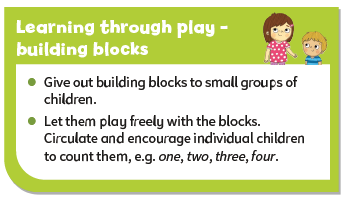
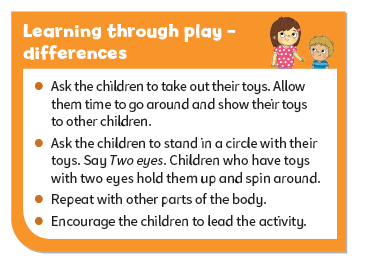
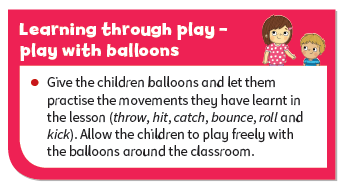
Learning through play is a key feature of our delightful pre-primary course, Pippa and Pop. Based around two children and their family bookshop, we also peep inside the marvellous miniature world of their toy mice, Pippa and Pop, who come alive in Kim’s imagination.
There are several suggestions about how to implement play in the classroom, with Learning through play activities in every unit.
Play in the early learning classroom is an area which deserves more time and space than we have available here, and many books have been written on the subject. We feel it’s worth remembering that play not only helps our learners, but also helps us as teachers and adults. As George Bernard Shaw wisely wrote,
“We don’t stop playing because we grow old; we grow old because we stop playing.”
To read more about the importance of play, please read our white paper, ‘Developing Life Skills in Play’, or read “Why does play matter?” by Allen Davenport.
References: Pippa and Pop Teacher’s Book 1, 2 and 3, written by Lucy Frino/Lily Pane with Caroline Nixon and Michael Tomlinson