


As English teachers, we’re always looking for ways to make our lessons more engaging and effective. A useful but often overlooked tool in our teaching arsenal is all the images our students can access in their coursebooks or the real world.
We live in a historical period where communication is more visual than ever. Whether scrolling through social media, watching videos, or consuming information through infographics, students today interact with images all the time. Another point to consider is that they are not only consumers of images but also creators: they take photos, make videos, and share digital content every day. Integrating the consumption and creation of images into our teaching can make a significant difference in student engagement and comprehension.
For obvious reasons, English language teaching often focuses more on text, leaving visual elements as secondary rather than central learning components. It is possible to make a move towards more visual classes but to make the best use of images in class, I believe we should bear in mind that students need our guidance to develop visual literacy, a range of skills that will enable them to analyze, interpret, and create their own images. Visually literate students understand and analyze the different elements involved in producing and using visuals. They are both critical consumers and competent creators of visual media.
Using images strategically can also level the playing field for students with different language skills. While text-heavy lessons can be intimidating for some learners, visual content provides context and meaning in ways that foster comprehension. A single image can spark discussion, evoke emotions, and serve as a foundation for meaningful language work.
Practical ways to use images in your classroom
If you’re wondering how to integrate images effectively into your lessons, here are some ideas for activities that work in various contexts. They have been adapted from Working with Images: A resource book for the language classroom, a title from the Cambridge Handbooks for Language Teachers written by Ben Goldstein.
1. Who am I?
In this activity, students create a role for a person from an image in the coursebook or any other image you bring to class.
- Draw students’ attention to the chosen image.
- Ask students to create a persona for the person in the image. You can prompt them with different questions, according to their linguistic level:
- What’s my name?
- Where am I?
- Why am I here?
- What’s happening?
- How am I feeling?
- What will happen next?
- What am I looking forward to?
- What do I wish most in the world?
- What do I regret?
- Students can then work in pairs to share their personas and ask questions to understand their partners’ choices.
This activity fosters creativity, visual literacy skills, and critical thinking while reinforcing vocabulary for descriptions, emotions, and settings, and practicing different verb tenses.
2. What’s missing?
In this task, students are challenged to notice how images connote/suggest meaning rather than tell meaning.
- Show students an image with a key part hidden or cropped out, as seen in the following example (part of the photo collage is covered by the purple square and question mark):

- Ask them to predict what might be missing and justify their guesses.
This activity helps students develop inferencing skills and encourages attention to detail.
3. Describing images: Points of view
The objective of this activity is to encourage students to take different points of view when describing an image.
- Display an image with a triggering question, then explain that they should answer it as if they were other people. In the following example, students have four possible “roles”:

This activity helps students develop empathy and understand that images are open to multiple interpretations.
4. Odd one out
In this activity, students categorize images to find the odd one out, explaining their choices. The activity can have multiple answers as long as students are able to justify their choices.
- Show students a set of related images (e.g., different types of food, travel destinations, or clothing styles):
- Ask them to choose which image doesn’t belong and explain their reasoning.

By encouraging multiple interpretations in this task, we help students shape their creative thinking abilities.
5. What does the bag “say”?
In this task, students analyze the contents of bags to speculate about their owners’ personalities, likes/dislikes, professional activities and others.
- Show students an image of an open suitcase or backpack filled with various items.
- Ask them to speculate about its owner based on the items they can see and how they are displayed:
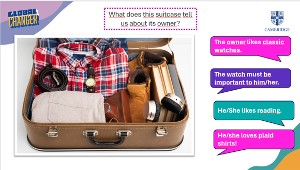
This activity enhances deductive reasoning and descriptive vocabulary, while revisiting vocabulary for personal belongings and personality traits. Students can also use modals of speculation in higher levels.
In my webinar ‘Unlocking the power of images: Practical strategies to promote visual literacy in class’, which you can watch here, I share other insightful activities to work with images and develop visual literacy in your classes.
Where to find engaging images
While coursebooks are a great source of high-quality images, there are many free and legal resources for finding compelling visuals:
- Unsplash (unsplash.com) – High-resolution, royalty-free images
- Pexels (pexels.com) – Free stock photos and videos
- Pixabay (pixabay.com) – A vast collection of free-to-use images
- Wikimedia Commons (commons.wikimedia.org) – A wide range of public domain images
- Student-Created Images – Encourage students to take photos or create drawings to illustrate concepts from lessons.
Integrating images into English lessons isn’t just about making classes more visually appealing—it’s about developing students’ ability to think critically, interpret visual media, and engage in meaningful discussions about visuals. By allowing images to take centre stage, we support language learning and prepare students to navigate a world dominated by visual communication.
References
Goldestein, B. (2008). Working with Images: A resource book for the language classroom. Cambridge: Cambridge University Press
Donaghy, K.; Xerri, D. (2017) The Image in English Language Teaching. Floriana: ELT Council
Kalantzis, M.; Cope, B. Works & Days. https://newlearningonline.com/kalantzis-and-cope
Kirmeliene, V., Santos, D. (2021) Global Changer 1. Cambridge: Cambridge University Press
Kirmeliene, V., Santos, D. (2021) Global Changer 3. Cambridge: Cambridge University Press
Kress, G.; van Leeuwen, T. (2021) Reading Images: The grammar of visual design. (3rd ed.). New York: Routledge